Thursday, October 31, 2013
Really Long Tweets
This "What If" from xkcd seems like a simple proportional reasoning problem--and could totally stay that way--but actually turns into something way more complicated, particularly when you consider growth over time.

Thursday, October 24, 2013
Friday, September 27, 2013
Poor Pete Tries Data Visualization
http://wtfviz.net/
The title may not be school-appropriate, but the awful data representations are a goldmine of "What's wrong with this?" problems.
The title may not be school-appropriate, but the awful data representations are a goldmine of "What's wrong with this?" problems.
What's Number Are You?
http://www.bbc.co.uk/news/world-15391515
According to this website, of all the people living on Earth, I was the 4,611,347,584th person to be born. Can you figure out how old I am???
There are lots of other interesting mathematical things about this. First, just the fact that the population of the Earth increased by about 2.5 billion people in my lifetime--more than half of what it was when I was born--is just staggering. I know that large numbers are hard for kids to conceptualize (adults too! me (non-kid, non-adult) too!), but there's something in here that makes you say WOAH. Even if you put in a kid's birthday (I picked a random 15 year old), there were still about 1 billion people born in their lifetime.
Of course there's also interesting stuff with exponential growth, how we would calculate this number, and so on. I'm also interested in the statistic of how many people have been born on Earth since the beginning of time. This website gives an interesting summary of that calculation, including this video:
According to this website, of all the people living on Earth, I was the 4,611,347,584th person to be born. Can you figure out how old I am???
There are lots of other interesting mathematical things about this. First, just the fact that the population of the Earth increased by about 2.5 billion people in my lifetime--more than half of what it was when I was born--is just staggering. I know that large numbers are hard for kids to conceptualize (adults too! me (non-kid, non-adult) too!), but there's something in here that makes you say WOAH. Even if you put in a kid's birthday (I picked a random 15 year old), there were still about 1 billion people born in their lifetime.
Of course there's also interesting stuff with exponential growth, how we would calculate this number, and so on. I'm also interested in the statistic of how many people have been born on Earth since the beginning of time. This website gives an interesting summary of that calculation, including this video:
The World Bank has a shorter video on the same topic:
I like the stat in this video that 7% of all the people who have ever lived are alive today. Holy smokes!
Monday, September 23, 2013
Record Setting Stupidity
http://recordsetter.com/
This is a proportional reasoning teacher's dream. All of those problems I've used about competitive eaters, giant foods, and other world records, here are videos to match! Those weird facts are already a good hook for kids, but reading about someone cramming hot dogs down their throat will never top actually seeing it.
This is a proportional reasoning teacher's dream. All of those problems I've used about competitive eaters, giant foods, and other world records, here are videos to match! Those weird facts are already a good hook for kids, but reading about someone cramming hot dogs down their throat will never top actually seeing it.
Saturday, September 21, 2013
Biggest Trig Warmup Ever
This looks so fun! What a way to get kids to think about the composition and decomposition of the "sweet 16" triangles on a unit circle. I haven't found many get-up-and-move-around activities that feel appropriate to high schoolers, so I love this. The materials prep isn't even that bad because you only need the two triangles.
Extra challenge for when you have more students in the class: throw in the angles an increments of 15degrees that aren't already part of the key unit circle angles. Really this is a physical variation on the question of how many angles you can build from just from a set of drafting triangles.
Extra challenge for when you have more students in the class: throw in the angles an increments of 15degrees that aren't already part of the key unit circle angles. Really this is a physical variation on the question of how many angles you can build from just from a set of drafting triangles.
Elevator Math
Eli Lansley of the Lansley Brothers Blog posted these pictures of interesting floor numbering systems in buildings.
The first he found in Israel, the second in Hackensack, New Jersey

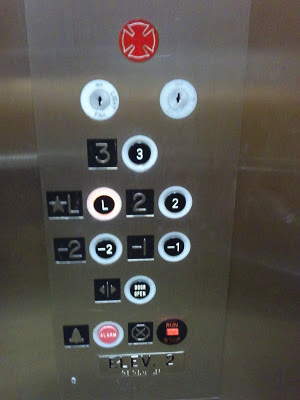
I have definitely taught kids to think about negative numbers and number lines by thinking about elevators. I don't know much about teaching younger grades or teaching negative numbers for the first time, but I can totally imagine giving kids a picture like this and asking them to describe the building where this elevator lives. Or some kind of problem about a building that adds an underground garage with the question "How should they label the number on the elevator button?" Even with the standard US systems for labeling underground space (P1, P2, P3 and stuff like that), I think it's interesting to talk about what order those should go in. Maybe it's not that exciting, but it feels like there's a little something there.
Also thinking about elevator numbering, I feel like there might be something with the way that many European countries label their floors by having floor 1 as the floor above the lobby. Or with Americans skipping the 13th floor. Is there some kind of function rule you can write to figure out how many floors the building actually has? It would be a piecewise function because the rule for calculating how many floors for buildings above 13 would be different than for buildings with fewer than 13 floors.
The first he found in Israel, the second in Hackensack, New Jersey
I have definitely taught kids to think about negative numbers and number lines by thinking about elevators. I don't know much about teaching younger grades or teaching negative numbers for the first time, but I can totally imagine giving kids a picture like this and asking them to describe the building where this elevator lives. Or some kind of problem about a building that adds an underground garage with the question "How should they label the number on the elevator button?" Even with the standard US systems for labeling underground space (P1, P2, P3 and stuff like that), I think it's interesting to talk about what order those should go in. Maybe it's not that exciting, but it feels like there's a little something there.
Also thinking about elevator numbering, I feel like there might be something with the way that many European countries label their floors by having floor 1 as the floor above the lobby. Or with Americans skipping the 13th floor. Is there some kind of function rule you can write to figure out how many floors the building actually has? It would be a piecewise function because the rule for calculating how many floors for buildings above 13 would be different than for buildings with fewer than 13 floors.
Subscribe to:
Posts (Atom)